There isn’t one right way to study for an amateur radio license.
Some people want a book they can sit down with and work through from beginning to end. Others prefer an interactive website, practice examinations, video instruction, a classroom, or another person explaining things across a table.
Many people learn best by combining several of those approaches.
The best study method is the one that gets you learning and keeps you learning.
Start With How You Learn
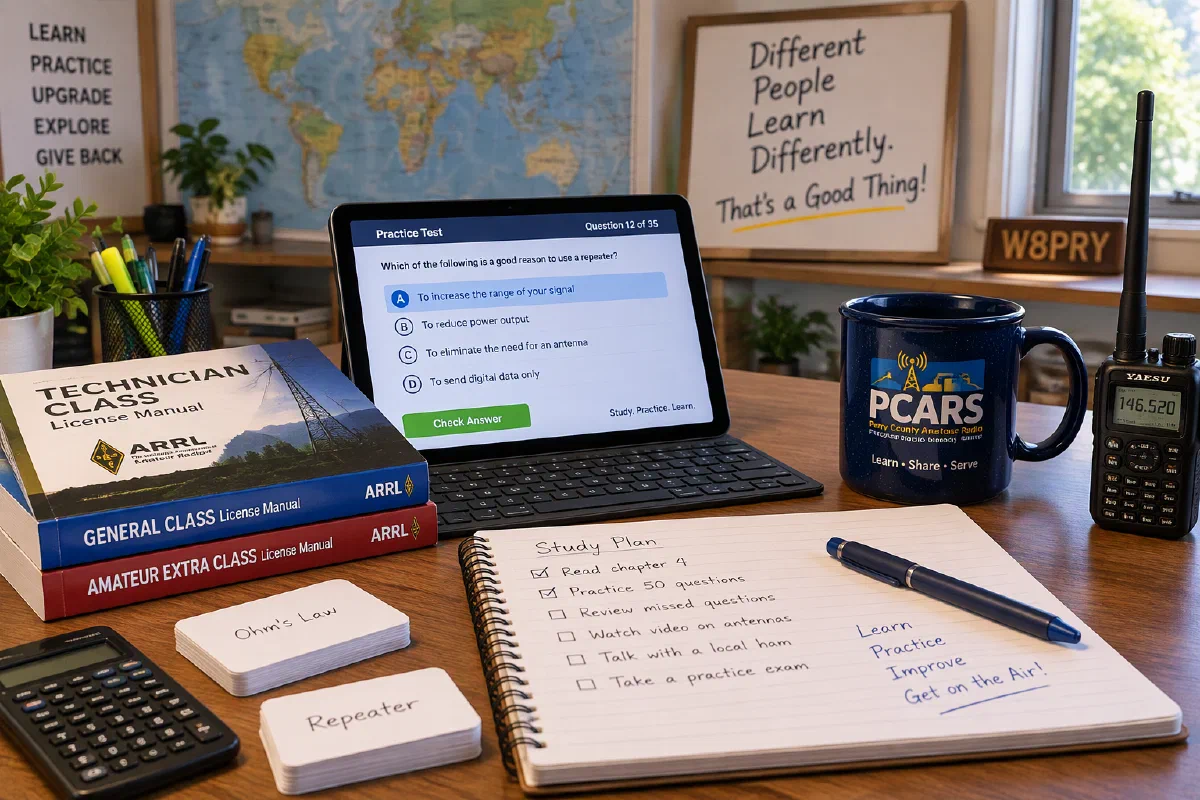
Before worrying about which book or website somebody says is “best,” think about how you normally learn something new.
Do you like reading detailed explanations?
Do you remember things better after answering questions?
Does watching someone demonstrate a concept make it click?
Do you need to understand why something works before you can remember the answer?
Would you rather have another person available when something doesn’t make sense?
There’s no wrong answer.
Your goal is not to study amateur radio the way somebody else thinks you should.
Your goal is to find a method that works for you.
If You Learn Best From Books
A traditional study guide can be an excellent choice if you like structured material that progresses from one subject to another.
Books give you time to stop, reread something, make notes, look at diagrams, and return to difficult material without feeling rushed.
There are several approaches available.
ARRL License Manuals
The American Radio Relay League publishes license manuals and other study material for the Technician, General, and Amateur Extra examinations.
These materials are organized around the subjects you’ll encounter while preparing for the examination and provide explanations intended to help you understand the underlying material rather than simply memorize an answer.
ARRL also publishes question-and-answer material for operators who prefer to work more directly with the examination question pools.
You don’t need to buy every book.
Choose the type of material that fits the way you study.
Gordon West Study Guides
Gordon West license-preparation books offer another established approach to the Technician, General, and Amateur Extra examinations.
The material organizes examination subjects and question-pool material in a conversational teaching style that some learners prefer.
If one author’s explanation doesn’t click for you, trying another author’s treatment of the same subject can sometimes make a surprising difference.
That’s one of the reasons PCARS doesn’t want to declare one study guide the winner.
KB6NU No-Nonsense Study Guides
KB6NU’s No-Nonsense Study Guides provide another book-oriented approach.
The current Technician Class guide for the 2026–2030 question pool is available as a free PDF.
The No-Nonsense approach reorganizes question-pool material into connected explanatory text instead of presenting the questions only as isolated test items.
Other formats are available, and KB6NU also offers material for the higher license classes.
For someone who prefers reading but wants to begin without buying a study manual, the free Technician PDF gives you another place to start.
If You Learn Best Interactively
Some people learn better when studying feels less like reading a textbook and more like an ongoing conversation with the material.
Interactive study systems can present questions, track progress, identify weak areas, and return to material that needs more attention.
One option is HamStudy.org.
HamStudy provides study tools for the current Technician, General, and Amateur Extra question pools, including question explanations, flash-card-style study, and practice examinations.
That approach can work particularly well for someone who wants immediate feedback while studying.
It can also be useful alongside a book.
Read about a subject.
Practice the questions.
Discover what you didn’t understand as well as you thought.
Go back and study that part again.
That’s learning too.
If Practice Exams Help You
Practice examinations can be extremely useful.
They let you become familiar with the style and structure of the actual examination and give you a rough idea of which topics need more work.
Resources with practice-exam capabilities include:
These are examples, not rankings.
Different sites present the material differently, and you may prefer one interface or teaching style over another.
Try them.
If one works for you, use it.
If it doesn’t, try something else.
Practice Tests Are a Tool, Not the Goal
It can be tempting to take practice examination after practice examination until you recognize enough answers to pass.
That may get you through the test.
But recognizing an answer and understanding what the answer means aren’t always the same thing.
On the other hand, you also don’t need to become an electrical engineer before you’re allowed to take the Technician examination.
There’s a reasonable middle ground.
Use practice tests to:
- Become comfortable with the exam format
- Identify weak subjects
- Reinforce things you’ve studied
- Measure your progress
- Build confidence before examination day
When you miss a question, don’t just memorize the letter beside the correct answer.
When possible, spend another minute asking:
Why is that the right answer?
That extra minute can turn a test question into something you’ll actually remember on the air.
If You Learn Best From People
Some concepts are simply easier when another person explains them.
Maybe the explanation in a book doesn’t make sense.
Maybe you understand the words but can’t visualize what’s happening.
Maybe you need to see an antenna, radio, connector, or circuit in front of you before the idea becomes real.
Ask someone.
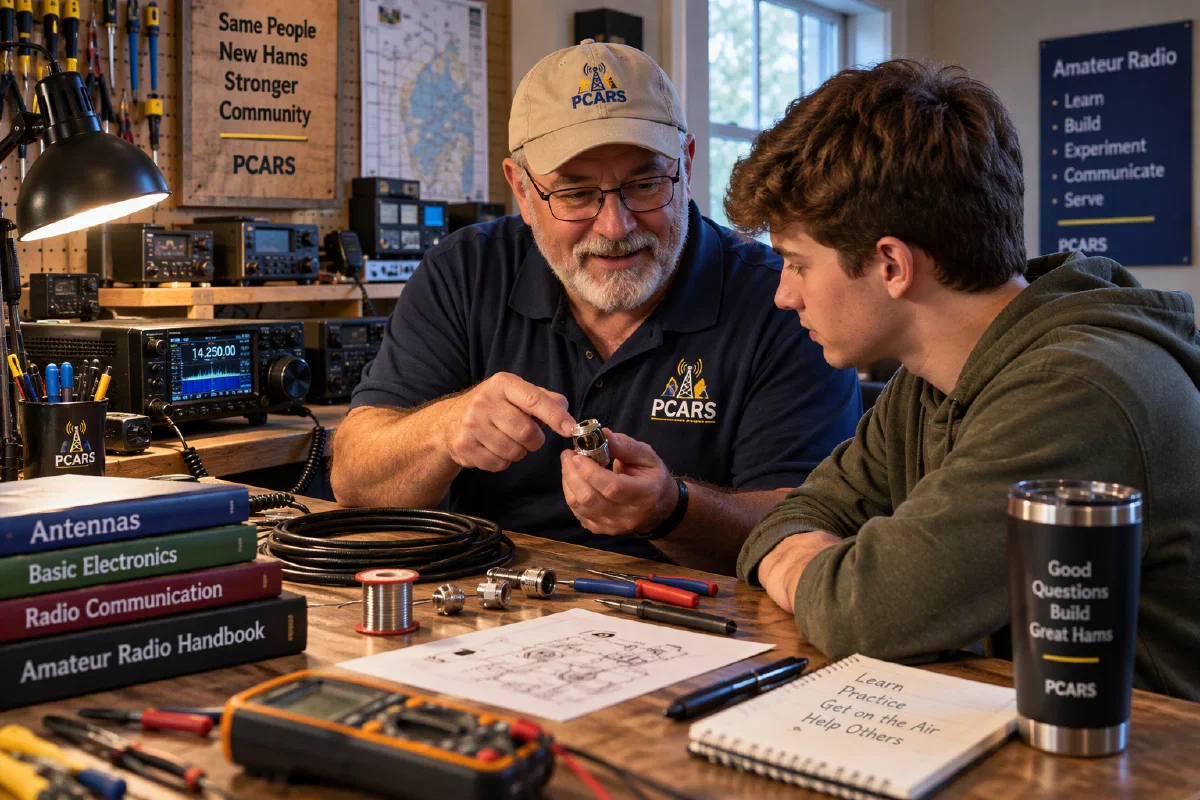
A local amateur radio operator, instructor, club member, or study group may be able to explain in five minutes what you’ve been fighting with for an hour.
And asking questions isn’t admitting that you’re bad at this.
It’s how people learn.
PCARS wants to encourage exactly that kind of mentoring.
Prefer a Live Class?
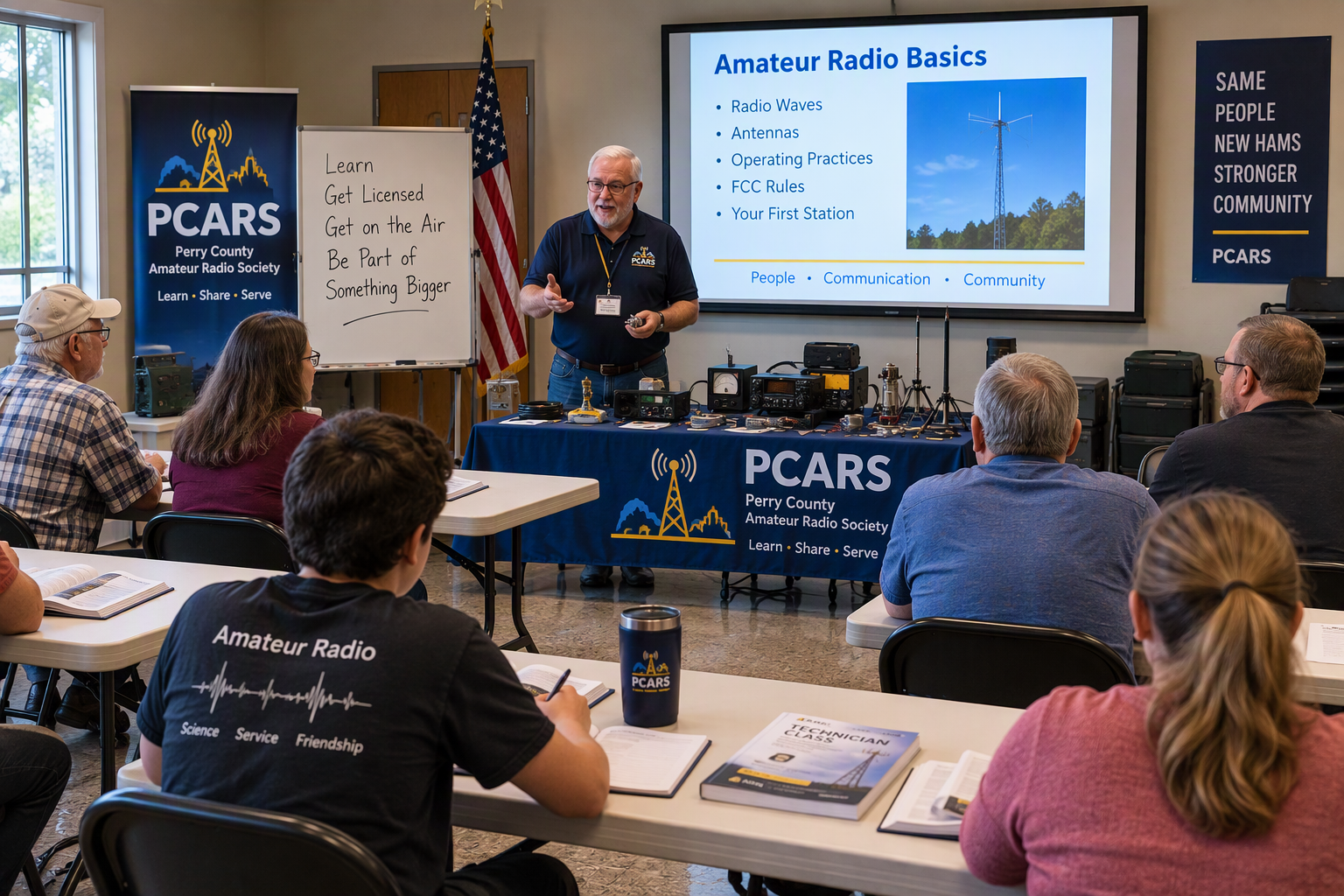
Some people learn best when there’s an instructor in the room.
Live instruction gives you something books and websites can’t always provide: the ability to stop, ask a question, hear the explanation another way, and work through a difficult concept with other people who are learning it too.
Amateur radio clubs and volunteer instructors offer license classes in many communities, and ARRL provides resources to support people who teach amateur radio licensing material.
PCARS does not currently maintain a regular license-class schedule.
We would like to change that as the organization grows.
If there’s enough interest, we’d like to help make live amateur radio license instruction available in Perry County, whether through PCARS, cooperation with other amateur radio organizations and instructors, or a combination of both.
So if you’d rather learn in a classroom than study entirely on your own, tell us.
Interest from prospective students helps us understand what Perry County actually needs.
And if you’re an amateur radio operator who’s interested in helping teach or mentor new operators, we’d like to hear from you too.
Teaching Is Learning Too
Building local instruction doesn’t require one person to know everything.
ARRL provides resources for volunteer license instructors, including teaching materials, lesson-planning resources, examination-practice aids, current question-pool resources, and guidance shared by other instructors.
PCARS can grow its teaching capability the same way we hope newcomers grow their radio skills:
Learn. Practice. Improve. Share what works.
A good instructor doesn’t need to have every answer memorized.
A good instructor needs to understand the material, prepare well, explain it clearly, and be willing to say:
“I don’t know. Let’s find out.”
That’s not a weakness in an instructor.
That’s demonstrating how learning actually works.
Resources for People Who Want to Teach
ARRL maintains resources specifically for amateur radio license instructors and mentors.
Its National Instructor Program supports volunteer instructors, and ARRL provides materials for license instruction including instructor guidance, teaching resources, presentation material, examination-practice aids, and information about the current question pools.
ARRL also provides a way for registered instructors to list upcoming license classes so prospective students can find them.
That gives PCARS something useful to build from rather than requiring us to invent an amateur radio course entirely from scratch.
As PCARS grows, we’d like to develop people who can teach, demonstrate, mentor, and help newcomers become comfortable both before and after the examination.
Because passing the test is useful.
Helping someone become an operator is better.
If Video Works Better for You
Video instruction can be useful when you learn by watching and listening rather than reading.
A good video can make subjects such as antennas, circuits, modulation, operating practices, and radio propagation easier to visualize.
As with books and websites, quality and teaching style vary.
Don’t assume the most popular presenter will automatically be the best instructor for you.
Try a lesson.
If the explanation makes sense, keep going.
If it doesn’t, find someone whose teaching style does.
Learn the Material or Learn the Question Pool?
You’ll sometimes hear different philosophies about license preparation.
One says:
Learn the material and the test will take care of itself.
Another says:
Pass the examination, get on the air, and then learn radio by doing it.
There’s value in both perspectives.
Passing the examination and understanding amateur radio are related goals, but they aren’t identical goals.
The exam establishes a baseline of regulatory, operating, safety, and technical knowledge.
Experience turns that knowledge into something practical.
Some people want to understand nearly every concept before taking the examination.
Others understand those concepts much more easily after they have a callsign, a radio, and a reason to apply them.
Both can become excellent amateur radio operators.
Study enough to pass responsibly.
Then keep learning.
Mix and Match
You don’t have to choose one study method and remain loyal to it.
You might:
- Read an ARRL or Gordon West study guide
- Use the free KB6NU Technician PDF for another explanation
- Practice questions with HamStudy
- Take occasional full practice exams
- Watch a video about subjects that aren’t clicking
- Ask a local operator about something you still don’t understand
That’s not cheating.
That’s using the resources available to you.
If three different explanations eventually cause the light bulb to come on, the important part is that the light bulb came on.
Make Sure Your Material Is Current
Whatever study method you choose, make sure the material matches the question pool that will be in effect when you take your examination.
As of November 2026, the current pool periods are:
- Technician: July 1, 2026 through June 30, 2030
- General: July 1, 2023 through June 30, 2027
- Amateur Extra: July 1, 2024 through June 30, 2028
This matters especially when buying used books, borrowing older study material, following an old video series, or finding a forgotten PDF somewhere online.
Old material can still contain perfectly good radio theory.
It may simply no longer match the examination you’re preparing to take.
Don’t Chase 100 Percent
A perfect score is nice.
It isn’t required.
More importantly, nobody is going to ask what score you received every time you identify on the air.
Your examination score doesn’t become part of your callsign.
The goal of practice exams is to help determine whether you’re prepared, not to create another hobby where you spend three weeks trying to improve a 94 to a 100.
If you’re consistently passing practice examinations and understand the areas where you’ve struggled, it may be time to stop polishing the practice score and take the real exam.
And if you’d rather keep studying until you feel more comfortable, that’s fine too.
Again:
Learn at your pace.
These Aren’t Your Only Options
The resources listed here are examples of established ways people prepare for amateur radio examinations.
They aren’t the only good choices, and PCARS isn’t suggesting that you have to use any particular book, website, course, or study method.
New resources appear, teaching styles differ, and sometimes the resource everybody else loves simply doesn’t work for you.
That’s okay.
If none of these options fit the way you learn, ask us.
We may be able to suggest another resource, help explain something that’s giving you trouble, connect you with another amateur radio operator, or simply help you figure out a different approach.
The goal isn’t to use the same study material everyone else uses.
The goal is to learn.
When Are You Ready?
There isn’t a magic number of study hours that applies to everyone.
If you’re using practice examinations, they can help you judge your readiness.
But also ask yourself:
- Do the common operating rules make sense?
- Do you understand the basic safety material?
- Are you recognizing concepts rather than only memorizing answer letters?
- When you miss questions, do you know what subject you need to review?
- Are you regularly passing representative practice examinations?
At some point, more studying stops adding much and taking the examination becomes the next useful step.
You don’t need to feel like an expert.
You’re applying for a license to begin participating in amateur radio.
The expertise comes later.
Learning Doesn’t End With the Exam
Whatever resource helps you pass the examination has done an important job.
But don’t throw curiosity away with your practice-question notes.
Once you’re licensed, things that seemed abstract during study begin becoming real.
A repeater isn’t a paragraph anymore.
An antenna isn’t a diagram.
Propagation isn’t merely a test question.
They’re things you’re actually using.
That’s when amateur radio starts teaching you in a different way.
Get on the air.
Experiment.
Ask questions.
Keep learning.
And when somebody new comes along, remember what it felt like when all of this was unfamiliar.
Help the next person.
What’s Next?
You’ve decided to get licensed.
You’ve found a way to study that works for you.
Eventually you’re going to need somewhere to take the examination.
How do I find an exam session?
If you’re having trouble finding study material that works for you, contact us at info@pcars.club.
We’ll help you look for another approach.