Getting an amateur radio license is probably easier than you think.
You don’t need an engineering degree. You don’t need years of electronics experience. And you don’t need to already own a radio.
You need to learn some basic operating practices, regulations, safety, and radio theory, then pass an examination.
That’s where most amateur radio operators started.
Why Is a License Required?
Amateur radio operators transmit on portions of the radio spectrum allocated to the Amateur Radio Service.
Those signals don’t necessarily stop at your property line. Depending on the frequency, equipment, antenna, propagation, and conditions, a transmission might cover a neighborhood, a county, several states, or travel much farther.
Operating privileges therefore come with responsibilities.
The licensing process establishes that an operator has demonstrated basic knowledge needed to operate an amateur station.
Think of the examination as the starting line, not the finish line.
The goal isn’t to prove that you already know everything about amateur radio.
None of us do.
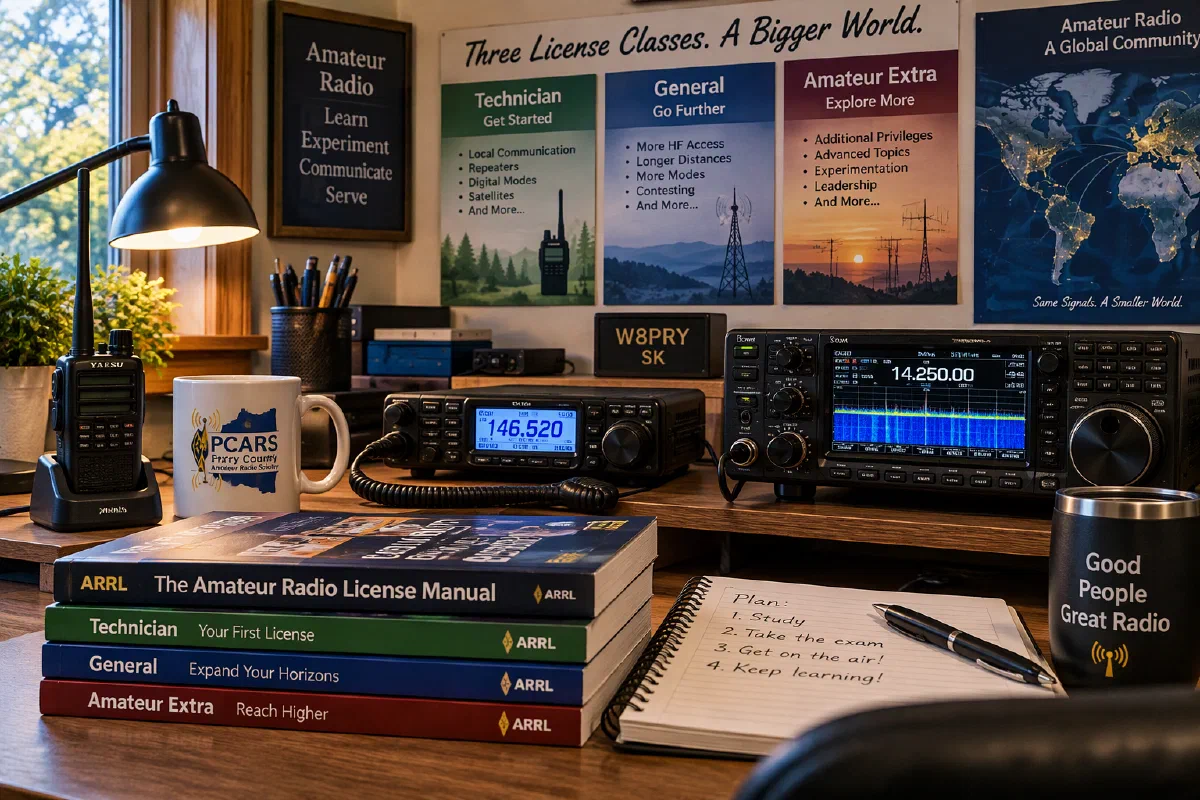
The Three License Classes
The United States currently has three amateur radio license classes available to new and upgrading operators:
- Technician
- General
- Amateur Extra
Each step provides additional operating privileges.
You don’t need to decide today how far you eventually want to go.
Most people begin with Technician.
Technician
The Technician Class license is where most new amateur radio operators begin.
The Technician examination contains 35 questions, and you must answer at least 26 correctly to pass.
Technician privileges provide substantial access to amateur frequencies above 50 MHz, along with some privileges on HF amateur bands.
In practical terms, Technician can introduce you to activities such as:
- Local voice communication
- Repeaters
- Simplex communication
- Digital voice
- Radio direction finding
- Amateur satellites
- Portable operation
- Public-service activities
- Emergency communications
- Technical experimentation
And that’s only a starting point.
A Technician license gives you plenty of amateur radio to explore while you determine what interests you most.
General
The General Class license is the next step.
The General examination is also 35 questions, with at least 26 correct answers required to pass.
General provides operating privileges across all amateur service bands and substantially expands access to HF frequencies.
HF is where many operators begin spending more time communicating across greater distances.
That can open doors to:
- Contacts throughout the United States
- International communications
- Long-distance voice operation
- Digital communications
- Morse code
- Contesting
- Portable HF operation
- Parks on the Air
- Other activities involving the HF amateur bands
You don’t have to upgrade immediately after earning Technician.
Some operators remain Technicians for years because the things they enjoy are already available to them.
Others begin studying for General almost immediately. Still others study for the Technician and General examinations together.
All three approaches are perfectly reasonable.
There isn’t a prize for upgrading quickly, and there isn’t anything wrong with moving ahead when you’re ready.
Learn at the pace and in the way that works for you.
Amateur Extra
Amateur Extra is the highest current amateur radio license class in the United States.
The Extra examination contains 50 questions, with at least 37 correct answers required to pass.
Amateur Extra provides additional amateur spectrum privileges, particularly in portions of the HF bands.
The examination covers more advanced operating and technical material than the earlier license classes.
Do you need an Extra license to be a “real” amateur radio operator?
Absolutely not.
License class determines operating privileges.
It does not determine someone’s value to the amateur radio community.
A new Technician who is curious, active, learning, and helping others is doing amateur radio just fine.
Do I Have to Learn Morse Code?
No.
There is no Morse-code examination requirement for the current Technician, General, or Amateur Extra licenses.
You may still encounter operators who learned Morse code as part of an earlier licensing system, and Morse remains an active and popular part of amateur radio.
But learning it is now a choice.
If Morse code interests you, learn it. After all, dots and dashes were digital communication long before computers came along.
If something else interests you more, start there.
What Is on the Test?
The exact material depends on the license class, but amateur radio examinations cover subjects related to safely and properly operating an amateur station.
For Technician, that means learning introductory material involving subjects such as:
- FCC rules and amateur radio regulations
- Operating practices
- Frequencies and band privileges
- Basic radio and electrical concepts
- Antennas and feed lines
- Station equipment
- Radio-wave behavior
- Electrical and RF safety
Don’t let that list intimidate you.
The Technician exam is intended for people entering amateur radio, not people who have already spent twenty years designing transmitters.
You learn it a piece at a time.
No Surprise Questions
One of the nicest things about amateur radio licensing is that the examination question pools are public.
The questions used to construct the examinations come from published pools that you can study before taking the exam.
That makes it possible to prepare using whatever methods work best for you:
- Books
- Online courses
- Classes
- Videos
- Flash cards
- Practice examinations
- Study groups
- One-on-one help
- A combination of several methods
PCARS doesn’t care which approach you choose.
We care that you find an approach that works for you.
Make Sure Your Study Material Is Current
Amateur radio examination question pools change periodically.
That means an old book or an abandoned website might contain material for a question pool that is no longer being used.
Before investing time in any study resource, verify that it covers the question pool that will be in effect when you take your examination.
As of November 2026, the current question-pool periods are:
- Technician: July 1, 2026 through June 30, 2030
- General: July 1, 2023 through June 30, 2027
- Amateur Extra: July 1, 2024 through June 30, 2028
That doesn’t mean an older book suddenly becomes useless for learning radio theory.
It does mean it may no longer be the right resource for preparing specifically for the current examination.
How Are Exams Given?
You don’t have to travel to some distant FCC office to take an amateur radio examination.
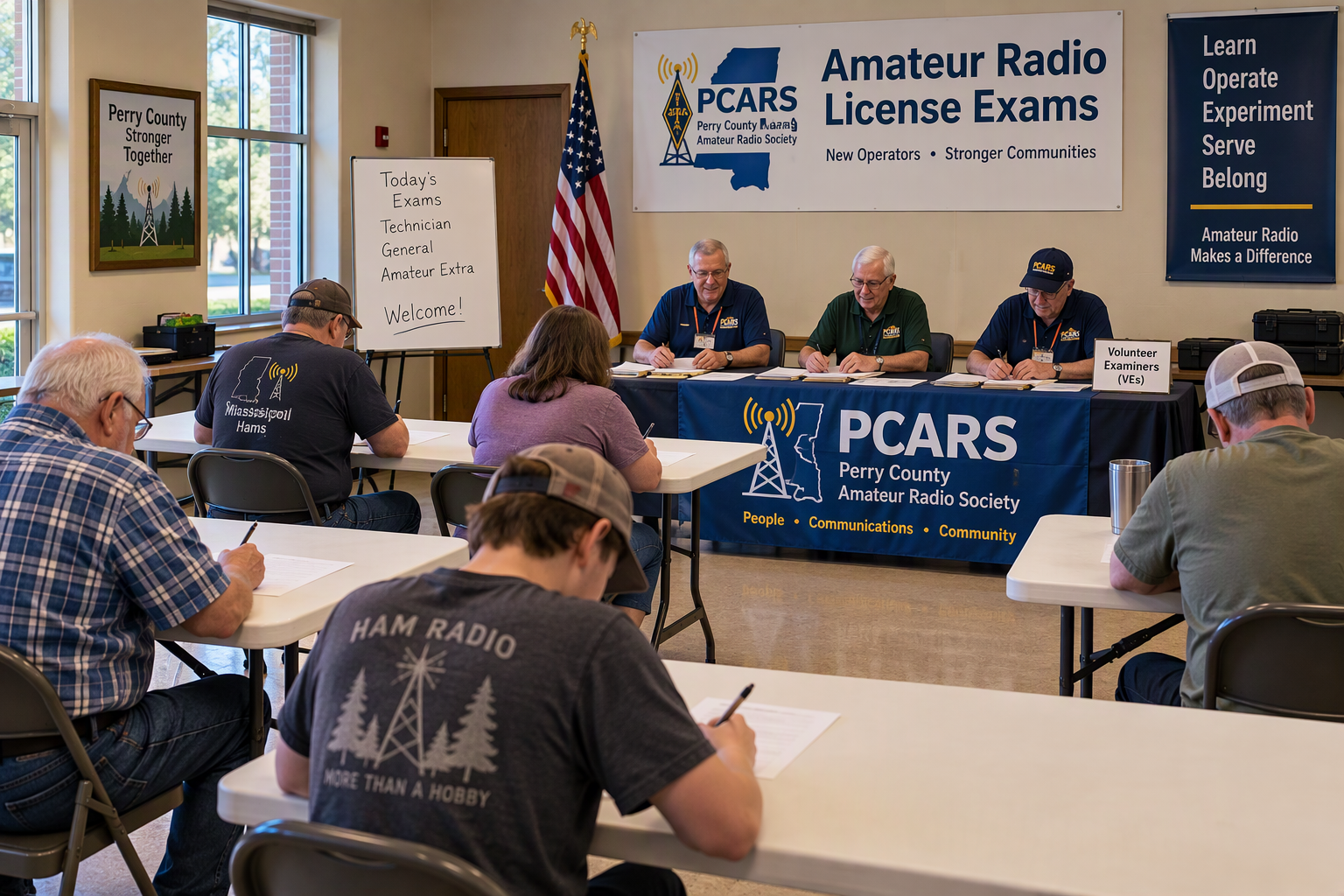
The exams are administered by licensed amateur radio operators called Volunteer Examiners, or VEs, working through organizations called Volunteer Examiner Coordinators, or VECs.
Southeast Mississippi has several active VE teams, with examination opportunities regularly available in places including Laurel, Hattiesburg, Lucedale, and Wiggins.
More importantly, these are members of our amateur radio community, not anonymous testing centers.
Some area teams are willing to arrange sessions for groups and help accommodate people who have difficulty traveling to a regular examination session, including shut-ins.
If accessibility, transportation, or another circumstance is keeping you from taking an exam, talk to us before deciding that getting licensed isn’t practical.
PCARS may not administer every examination itself, but we can help people find the operators and VE teams around Southeast Mississippi who do.
Current public sessions can also be located through ARRL and Laurel VEC examination-session searches.
We’ll go into the details in Finding an Exam Session.
If You Pass, Keep Going. If You Want
Some of the VE teams in our area will allow, and often encourage, you to try the next license-class examination if you pass the one you came to take. Some have tighter schedules and only enough time set aside to provide one test session.
If you arrive to take your Technician exam and pass it, you may therefore have the opportunity to try General while you’re already there.
If you’ve been studying for both, that’s obviously useful. Even if you haven’t, there’s often little reason not to give the next exam a try when the team offers the opportunity. You may know more than you think, and seeing the next examination can give you a better idea of what you’ll want to study later.
Passing one examination doesn’t obligate you to take another.
But don’t be surprised if the VE team congratulates you and then asks:
“Want to try the next one?”
If that’s not available at your particular session, that’s fine too.
You passed the exam you came to take.
Celebrate that one first.
What If I Almost Pass?
Missing the passing score by a few questions doesn’t necessarily mean your testing session is over.
Some VE teams in our area may offer another attempt during the same session when time and circumstances permit. Policies can vary by team and the VEC they’re working through, so simply ask what options are available.
If another attempt is available, take a breath before jumping straight back in. Look at what gave you trouble and decide whether you’re ready to try again.
And if today isn’t the day, that’s okay too.
You didn’t fail at amateur radio. You found the part you need to study next.
Can I Take More Than One Exam?
The amateur licensing system is progressive.
Technician corresponds to examination Element 2.
General requires Elements 2 and 3.
Amateur Extra requires Elements 2, 3, and 4.
When you upgrade, you receive credit for examination elements you’ve already passed, so you don’t keep retaking the earlier elements every time you advance.
As we just discussed, many VE teams will offer the next examination element when you pass, when their schedule and procedures allow it.
But don’t feel pressured to rush.
The goal isn’t to collect license classes as quickly as possible.
The goal is to learn radio and gain the privileges you actually want to use.
What Happens After I Pass?
Passing the examination is an important milestone, but the examination itself is not your authority to begin transmitting.
You need an amateur operator license grant from the FCC before operating an amateur station under your new privileges.
Once the license grant is issued, you’ll have a callsign assigned to you.
That callsign becomes your on-air identity.
You’ll use it to identify your station when operating and will probably discover fairly quickly that hearing your own callsign come back over the radio is a lot more satisfying than answering another practice-test question.
Then the real learning starts.
What Is a Callsign?
When the FCC grants your amateur radio license, your station is assigned a unique callsign.
That callsign becomes your identity on the air. You’ll use it to identify your station when transmitting, and before long you’ll probably recognize the callsigns of people you regularly talk with almost as readily as their names.
A U.S. amateur radio callsign is generally made up of three parts:
- A one- or two-letter prefix
- A single numeral
- A one-, two-, or three-letter suffix
For example:
W8PRY
is a 1×3 callsign:
W    8    PRY
│    │     │
│    │     └── three-letter suffix
│    └──────── numeral
└───────────── one-letter prefix
And:
NI5I
is a 2×1 callsign:
NI    5    I
│     │    │
│     │    └── one-letter suffix
│     └─────── numeral
└───────────── two-letter prefix
What’s a 1×3, 2×2, or 2×1?
Hams often describe callsigns using shorthand such as 1×3, 2×3, 2×2, 1×2, and 2×1.
The first number tells you how many letters are in the prefix.
The second tells you how many letters are in the suffix.
The numeral in the middle isn’t counted.
| Format | Example pattern |
|---|---|
| 1×3 | W5ABC |
| 2×3 | KD5ABC |
| 2×2 | KA5AB |
| 1×2 | W5AB |
| 2×1 | NI5I |
Those examples explain the shape of a callsign. They do not mean that every format is available to every license class, or that the FCC is currently issuing every eligible format through sequential assignment.
What Will I Get as a New Technician?
If you’re receiving your first Technician license, don’t expect the FCC to assign you a short 1×2, 2×1, or 2×2 callsign.
A new Technician in our area will normally receive a sequentially assigned 2×3 callsign.
A 2×3 callsign has:
- Two letters in the prefix
- One numeral
- Three letters in the suffix
The general format looks like this:
KI5ABC
KJ5ABC
KK5ABC
These are examples of the 2×3 format, not predictions of specific callsigns that are available or will be assigned.
The FCC assigns callsigns from regional lists. When the available callsigns in one regional group are exhausted, sequential assignment moves to the next applicable group.
That is why the table of callsign groups can show Technician and General operators in Group C while a newly licensed Technician actually receives a Group D-style 2×3 callsign.
The exact callsign depends on where the FCC sequential assignment system has reached when the license is processed.
So the practical expectation for a new Technician here is:
two letters, one number, and three more letters.
So Where Do the Short Callsigns Come From?
Some shorter callsign formats have additional license-class eligibility requirements.
An Amateur Extra operator may request eligible callsigns from Groups A, B, C, or D through the FCC vanity system. Technician and General operators may request eligible callsigns from Groups C or D.
That means an Amateur Extra operator can be eligible for shorter callsign formats that aren’t available to a Technician or General operator.
But there’s another important point:
Upgrading your license doesn’t automatically change your callsign.
You may hear an Amateur Extra using a perfectly ordinary 1×3 callsign because that’s the callsign the operator already had and wanted to keep.
Likewise, hearing a short callsign doesn’t tell you how long someone has been licensed, how active someone is, or how much someone knows about radio.
It’s an identifier, not a rank insignia.
What’s a Vanity Callsign?
After you’re licensed, you’ll probably hear people talk about vanity callsigns.
A vanity callsign is a specific eligible callsign requested by a licensee instead of simply accepting a callsign through the normal sequential assignment system.
The FCC allows licensees to request eligible available vanity callsigns, but availability, operator-class eligibility, geographic rules, and other requirements apply.
Some operators choose vanity calls because they’re shorter.
Some choose calls that have personal significance.
Some find one that’s easier to say or remember.
And plenty of operators simply keep the callsign the FCC originally assigned.
There’s nothing wrong with that.
Does the Number Tell Me Where Someone Lives?
Historically, the numeral in a U.S. amateur callsign has been associated with a geographic call area.
The FCC’s sequential system still uses regional lists based on operator class and mailing address when assigning callsigns.
But don’t assume the numeral tells you where an operator is physically located when you hear that station today.
For a new operator, the useful lesson is simpler:
The letters and number together form the callsign. The whole thing identifies the station.
You’ll Get Used to Them Quickly
Callsigns look strange when you’re new to amateur radio.
They don’t stay strange for very long.
Soon you’ll hear a familiar callsign and immediately think of the person you talk with every Wednesday night, the operator who helped with your antenna, or the voice that’s always on the local repeater.
Your own callsign will start feeling natural too.
And the first time you call another station and hear your new callsign come back over the radio?
That’s when this whole licensing business starts becoming real.
What If I Don’t Pass?
Then you learned where you need a little more work.
That’s it.
Failing an amateur radio examination doesn’t mean you’re bad at radio, bad at electronics, or incapable of becoming licensed.
Some people pass their first attempt easily.
Others need more study or a different learning approach.
What matters is figuring out what didn’t click and trying again.
Remember the philosophy we’ve already established:
Use what works for you. Keep learning.
Don’t Study Alone Unless You Want To
Some people genuinely prefer studying alone.
That’s fine.
But if something in the material doesn’t make sense, don’t spend three evenings getting angry at the same paragraph because you think you’re supposed to figure everything out yourself.
Ask someone.
Sometimes a concept that seems impossible in a book becomes obvious when another operator explains it differently or demonstrates it with actual equipment.
That’s one of the reasons organizations like PCARS exist.
Your License Is Permission to Begin
It’s easy to become so focused on passing the examination that the examination begins to feel like the objective.
It isn’t.
Your license gives you access to something much larger.
Once you’re licensed, use it.
Make a contact.
Check into a net.
Try a repeater.
Listen to HF.
Set up an antenna.
Take a radio outside.
Ask somebody to show you something unfamiliar.
Make mistakes.
Figure out why something didn’t work.
That’s how the material in the study guide gradually becomes radio knowledge.
What’s Next?
Now that you understand the basic licensing path, the next question is:
How should I study?
There isn’t one answer that works for everybody.
The next guide explores books, online tools, practice exams, live instruction, mentoring, and other approaches so you can find what works for you.
If you have questions or would like help getting started, contact us at info@pcars.club.